
Every old house has a history. Some are fortunate enough to have more than one.
When Laura and I began Domaine Chardonnay, our five-acre vineyard estate in Temecula Wine Country, we started with a peculiar premise: rather than design a new house in an old style, we would imagine that an old house was already there.
In our minds, Domaine had already begun life somewhere in the Rhône Valley—a country manor of stone and plaster, accompanied, as such places occasionally are, by a small detached chapel. Generations later, its owners had found themselves requiring rather more comfortable accommodations. A great room appeared. A new wing followed. Modern necessities were introduced. But each addition was expected to show a certain deference to what had come before.
Not imitation, exactly.
Respect.
That distinction became the governing principle of the estate.
The newest chapter is Petite Domaine, which we ironically imagined as something older still: the manor’s original gatehouse, the old carriage house and small abbey, a collection of working buildings once standing at the edge of the estate and eventually reclaimed for another purpose.
Today those imagined remnants contain guest suites, a cloister, courtyards and an intimate wine bar. They have been connected and adapted for contemporary life, but we resisted the temptation to make every new element pretend to be old.
Indeed, some of the pleasure comes from doing precisely the opposite.
- A guest arriving at Petite approaches through olives, Italian cypress, lavender, Russian sage and roses. Beyond a stone arch lies a courtyard of cloisters, iron doors and running water. The architecture suggests another century.
Then one opens the doors to the wine bar.
Inside, the mood changes entirely: black alligator cabinetry, black-and-white stone, gold, chandeliers and contemporary furnishings. The intention is that brief and rather wonderful moment of surprise:
I did not expect this.
And that, in many ways, is the point.
Domaine is not an attempt to recreate Europe in Southern California, nor is Petite meant to be a stage set suggesting a past that never existed. We are interested instead in the idea of an estate that has evolved—one in which older architectural forms have been preserved, altered, contradicted and occasionally sharpened by the needs and tastes of another generation.
I have come to describe the idea as ‘romantic adaptive classicism’.
It was only after Domaine was well established—and Petite already taking shape—that I happened upon an architectural kindred spirit. A stay at the Grand Del Mar led me to the work of acclaimed architect Addison Mizner, and as I began reading about him, I found myself recognizing instincts I had been following for years without quite knowing where they belonged.
Mizner understood that architecture is not merely a building. It is procession and surprise; landscape and shadow; courtyards, furniture, ironwork, fountains and the particular pleasure of wondering what might be beyond the next arch. His willingness to interpret European precedent rather than reproduce it literally felt immediately familiar.
There is, however, an important difference.
Mizner often delighted in persuading a new building to behave as though it were old. I am less interested in concealing the passage of time than in inventing it. The contemporary elements at Domaine are allowed to be contemporary. The old-world architecture does not require every table, paving stone or interior to pledge allegiance to the seventeenth century.
Sometimes a crisp plane of concrete is exactly what an old stone wall needs.
- My own background perhaps explains some of this. I began as a landscape architect and architectural designer, but over time the distinctions between architecture, landscape, construction and development mattered less to me than the experience they could create together. With Domaine, that thinking expanded naturally to include the vineyard, the winery and hospitality itself.
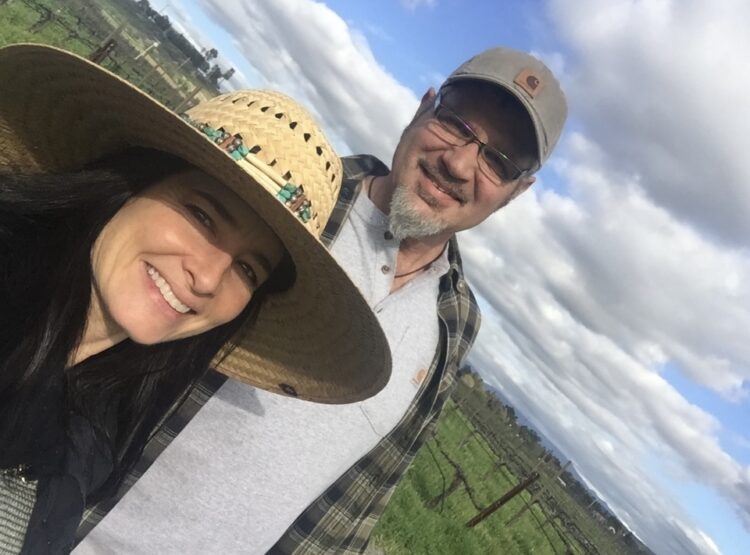
Laura brought an entirely different sensibility to the project. Her background in fashion and interiors introduced an instinct for proportion, texture, color and atmosphere that architecture alone could never provide. Somewhere along the way, our separate disciplines ceased to feel very separate at all. We were no longer simply designing a house or decorating its rooms; together, we were creating a place.
That distinction matters to us.
At Domaine, the garden is not something one applies after the architecture is complete. A courtyard is a room. An olive tree can be an architectural element. A distant vineyard framed through an opening can perform the work of a painting. A fountain is as much about sound as stone. And sometimes the most memorable moment in a building is not the grand room at all, but the passage one takes to reach it.
Petite Domaine is now nearing completion. The architecture is essentially finished, while the landscape is beginning the slower work that architecture cannot do for itself: softening edges, occupying walls, spilling into paths and giving a new place the first suggestions of age.
In another few years, the vines will have taken possession of the cloister. The olives will have settled in. The roses will have become somewhat unruly.
We rather look forward to that.
We would be delighted to share Domaine Chardonnay and Petite Domaine with you—not simply as a finished project, but as an architectural story about invention, memory, contrast and the curious way a place can acquire a history before it has actually had time to live one.
Yours truly,
Michael Wieters